
“ In the age of the iconoclasts, modelling—the coarse Roman modelling—begins to bulge and curl luxuriously at Constantinople. The eighth century in the East is a portent of the sixteenth in the West. It is the restoration of materialism with its paramour, obsequious art. The art of the iconoclasts tells us the story of their days ”
Iconoclasts
Definition and stakes
The theme of “iconoclasts” has been addressed by authors such as Clive Bell, Various, W. M. Flinders Petrie, P. L. Jacob and Eugène Viollet-le-Duc. It is often associated with terms like sculpture, ancient, art, Acropolis and Athens.
Quotes about “iconoclasts”
Various, Encyclopaedia Britannica, 11th Edition…
“ The Iconoclasts left an indelible impress on the Christian art of the Greek Church, in so far as they put an end to the use of graven images; for the Eastern icon is a flat picture, less easily regarded than would be a statue as a nidus within which a spirit can lurk. Half the realm of creative art, that of statuary, was thus suppressed at a blow; and the other half, painting, forfeited all the grace and freedom, all the capacity of new themes, forms and colours, all the development which we see in the Latin Church. ”
 W. M. Flinders Petrie,
Methods & Aims in Archaeology
W. M. Flinders Petrie,
Methods & Aims in Archaeology
“ Exhaustion may prove a point; as, for instance, the Iconoclasts in Greece or Reformers and Puritans in England were the only destroyers of images and pictures, or Akhenaten was the only man who erased the name of Amen. Such destructions therefore are evidence of the age and the man. ”
P. L. Jacob, The Arts in the Middle Ages and at the Period of the Renaissance
“ But fashion and the prevailing taste now required from artists nothing but profane and voluptuous compositions, and they adopted this line of Art all the more readily, seeing, as they did every day, most beautiful works of Christian sculpture mutilated by a new tribe of Iconoclasts, the Huguenots, who seldom showed mercy to the figured monuments in Catholic churches. ”
 Eugène Viollet-le-Duc,
Translation:Dictionary of French Architecture from the 11th to 16th Century
Eugène Viollet-le-Duc,
Translation:Dictionary of French Architecture from the 11th to 16th Century
“ Each compartment of the ornamentation is carved in a height of base. Unfortunately the hand of the iconoclasts of 1792 passed by there, and the majority of the figures placed in the corner pieces were mutilated. As for the small low-reliefs arranged under the tympanums, they were used as goal with the stones of the children during strong a long time. These low-reliefs can go hand in hand with what the ancient sculpture produced of more beautiful. ”
Stephen Salisbury, The Mayas, the Sources of Their History
“ They vented their rage most particularly on the effigies and portraits of the ancient kings and rulers of the vanquished, when and where they could find them, decapitating most and breaking a great many of the beautiful statues wrought by their subjects in their honor, as mementoes by which they remembered and venerated their memories. Chaacmol, whose hiding place they ignored, as they did that of his elder brother, Huuncay, whose statue is still where his friends deposited it, 12 meters under the surface of the ground, escaped the fury of the enraged iconoclasts. ”
 William James Stillman,
The Atlantic Monthly
(1866)
William James Stillman,
The Atlantic Monthly
(1866)
“ His intaglio ceased to be ornamentation, and passed into the category of ideal work. And there are intaglii of Greek workmanship which are as lovely as it is possible to conceive anything,—all the spirit and perfect proportion of the antique sculpture concentrated in an oval, an inch by three quarters of an inch, executed with a delicacy which defies the naked eye to measure it! A critical study of gems is an affair of years; yet, so far as all principles of design are concerned or characteristics of art, we may always consider the intaglii with the sculpture of the same epoch. ”
Percy Gardner, Sculptured tombs of Hellas (1896)
“ The sculptures which adorn these curious constructions have also local elements, but in this field the art of Ionia comes in as a controlling force in the sixth century, rendering the native customs and beliefs in forms to which the student of Greek art is accustomed. It may be that our familiarity with the forms and style of the sculpture in some degree misleads us. When we know the words of a language we sometimes too hastily think that we are masters of its thought. The religion and the customs of Lycia may resemble those of Greece less closely than the monuments would lead us to think. ”
F. B. Tarbell, A History of Greek Art
“ Again, it is important to recognize that the creations of Greek sculpture which have been preserved to us are partly original Greek works, partly copies executed in Roman times from Greek originals. Originals, and especially important originals, are scarce. The statues of gold and ivory have left not a vestige behind. Those of bronze, once numbered by thousands, went long ago, with few exceptions, into the melting-pot. Even sculptures in marble, though the material was less valuable, have been thrown into the lime-kiln or used as building stone or wantonly mutilated or ruined by neglect. ”
B. F. Cocker, Christianity and Greek Philosophy
“ The Propylæa, the Parthenon, and the Erechtheum, those peerless gems of Grecian architecture, are now in ruins. The magnificent sculpture of Phidias, which adorned the pediment, and outer cornice, and inner frieze of these temples, and the unrivalled statuary of gods and heroes which crowded the platform of the Acropolis, making it an earthly Olympus, are now no more, save a few broken fragments which have been carried to other lands, and, in their exile, tell the mournful story of the departed grandeur of their ancient home. ”
Churchill Babington, An introductory lecture on archæology (1865)
“ Besides the sculptures named by him we have in the British Museum a bas-relief by Scopas, as it is thought, who may also be the author of the Niobid group at Florence; likewise the Ceres (so-called) from Eleusis, and the statue of Pan from Athens, now in our Fitzwilliam Museum. For other antique statues and bronzes and for the later copies see Müller’s Ancient Art, passim. With the Greek schools of painting, Attic, Asiatic, and Sicyonian, no less celebrated than their sculpture, it has fared far worse. There is not one of their works surviving; no, not one. ”
Walter Frederic Adeney, The Greek and Eastern Churches (1908)
“ Although the iconoclastic movement sprang from the enlightened policy of two dynasties of strong emperors, while the practice of image worship was maintained by the ignorant populace and the fanatical monks, it must not be supposed that the latter lacked capable and high-minded defenders. On the contrary, the ablest theologian in each of the two periods of Iconoclasm was a champion of image worship. To the first period belongs John of Damascus, and to the second Theodore of Studium, the only churchmen of permanent fame who appeared in the Eastern Church during the eighth and ninth centuries. ”
 Vernon Lee,
Renaissance Fancies and Studies
Vernon Lee,
Renaissance Fancies and Studies
“ Given the sculpture of the Ægina period, it is impossible we should not arrive at the sculpture of the time of Alexander: the very constitution of clay and bronze, of marble, chisel and mallet, let alone that of the human mind, makes it inevitable ”
F. B. Tarbell, A History of Greek Art
“ In fact, there is only one indisputable case where we possess both a statue and the pedestal belonging to it, the latter inscribed with the name of an artist known to us from literary tradition. (See pages 212-3.) Thirdly, we have the actual remains of Greek sculpture, a constantly accumulating store, yet only an insignificant remnant of what once existed. These works have suffered sad disfigurement. Not one life-sized figure has reached us absolutely intact; but few have escaped serious mutilation. ”
 W. H. Withrow,
The Catacombs of Rome, and Their Testimony Relative to Primitive Christianity
W. H. Withrow,
The Catacombs of Rome, and Their Testimony Relative to Primitive Christianity
“ Inscriptions are placed above the paintings in order that the letter may explain what the hand has depicted.” [349] The feeblest intelligence might rise through the material [Pg 222] to the conception of spiritual truth. [350] But this ecclesiastical employment of art speedily became the source of religious corruption and the object of superstitious worship. At length it provoked the stern iconoclasm of the Isaurian Leo and his successors, and was formally prohibited by the general Council of Constantinople in the eighth century. ”
Blanchard Jerrold, How to See the British Museum in Four Visits
“ The collection of sculpture now popularly known as the Xanthian marbles, are a few ruins gleaned from the rocky eminence which is the site of ancient Xanthus. These fragmentary remains of an ancient people consist chiefly of sculptures from their temples and their tombs; upon which, like the Egyptians, they appear to have expended a vast amount of labour, and to have employed their greatest artists. The Greek mind is clearly traceable in these Xanthian marbles,—the Greek imbued with local traditions and feelings. ”
1911 Encyclopædia Britannica (1911)
“ COLOSSUS, in antiquity a term applied generally to statues of great size (hence the adjective “colossal”) , and in particular to the bronze statue of the sun-god Helios in Rhodes, one of the wonders of the world, made from the spoils left by Demetrius Poliorcetes when he raised the siege of the city. The sculptor was Chares, a native of Lindus, and of the school of Lysippus, under whose influence the art of sculpture was led to the production of colossal figures by preference. ”
 Stephen Graham,
A Tramp's Sketches
Stephen Graham,
A Tramp's Sketches
“ An ikon has been set up within the old building, and the latter is already a place of worship. Once more: to the eye of a monk a ruined temple is somewhat of an insult to God. There is no fond antiquarianism; all the old Latin inscriptions and bas-reliefs that have been found have been mortared together at random into one wall; all the human bones that have been unearthed, and they are many, have been thrown unceremoniously into an open box. Even on the bare white ribs and ancient crumbling skulls, bourgeois visitors have written their twentieth-century names. ”
 Mark Twain,
The Innocents Abroad — Volume 04
Mark Twain,
The Innocents Abroad — Volume 04
“ What a world of ruined sculpture was about us! Set up in rows—stacked up in piles—scattered broadcast over the wide area of the Acropolis—were hundreds of crippled statues of all sizes and of the most exquisite workmanship; and vast fragments of marble that once belonged to the entablatures, covered with bas-reliefs representing battles and sieges, ships of war with three and four tiers of oars, pageants and processions—every thing one could think of. ”
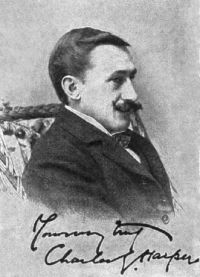 Charles G. Harper,
The Ingoldsby Country: Literary Landmarks of the "Ingoldsby Legends"
Charles G. Harper,
The Ingoldsby Country: Literary Landmarks of the "Ingoldsby Legends"
“ It is chiefly of Early English architecture, and an exquisite example of its period, with a noble chancel like the choir of a cathedral, and a remarkable crypt or undercroft, stacked with a neatly-disposed heap of many hundreds of skulls and large quantities of human bones. No one knows in any definite manner how, why, or when these gruesome relics were brought here, but legendary lore tells how they are the remains of those who were slain in some uncertain fight—so uncertain that whether between Britons and Romans, Romano-British and Saxons, or Saxons and Danes is not stated. ”
Edward Edwards, Lives of the Founders of the British Museum… (1870)
“ These sculptures to which I refer must be the work of the sixth or seventh centuries before the Christian era, but I have not seen an instance of these remains having 647been despoiled for the rebuilding of walls; and yet the decidedly more modern works of a later people are used as materials in repairing the walls around the back of the city and upon the Acropolis; many of these have Greek inscriptions, with names common among the Romans. The whole of the sculpture is Greek, fine, bold, and simple, bespeaking an early age of that people. ”
John Jessopp, Surrey Archaeological Collections…
“ Sculpture half destroyed, statues mutilated by the hand of man, or yielding to the decay of time, fantastic figures in every form of poetical grotesqueness, inscriptions scarcely legible, or of which the very allusion cannot be traced;—all these present a vague and mysterious analogy to those hieroglyphics of the elder world, of which the eye curiously follows the sharp outlines without the mind being able to comprehend or guess at the hidden meaning. ”
F. B. Tarbell, A History of Greek Art
“ We shall see that when a truly Greek art came into being, figures of goddesses and women were decorously clothed.Excavations on Mycenaean sites have yielded quantities of small figures, chiefly of painted terra-cotta (cf. Fig. 43) , but also of bronze or lead. Of sculpture on a larger scale we possess nothing except the gravestones found at Mycenae and the relief which has given a name, albeit an inaccurate one, to the Lion Gate. The gravestones are probably the earlier. ”
William James Stillman,
The Atlantic Monthly
(1866)
“ Some of these are the perfection of intaglio: nothing in the gem-cutting of the Greeks could be more exquisite and purely beautiful than they are as intaglio. Yet, excellent as is the work, there is an essential difference between the Etruscan and Greek design, which no similarity of workmanship will ever conceal,—a difference as radical as that between Roman and Greek sculpture, and still more marked. ”
 Alfred John Church,
Callias: A Tale of the Fall of Athens
Alfred John Church,
Callias: A Tale of the Fall of Athens
“ This represented the gods in council at Olympus. It was faced on the opposite wall by an exceedingly graceful painting from the hand of Xeuxis, Aphrodite and the Graces, and a spirited picture by the same artist, of the duel between Ajax and Hector. There were other works by men of less note. Sculpture was represented by only a single specimen, a bust of Socrates.“Paintings are easily carried about,” Alcibiades afterwards explained to his guest, “but sculpture is inconveniently heavy. You will understand that a man in my situation has always to be ready for a move ”
Charles Bucke, Ruins of Ancient Cities (Vol. 1 of 2…
“ In the tympanum of the pediment, over the eastern front, Stuart observed several holes in the marble, where metal cramps had been fixed for sustaining sculpture in entire relief, as over the eastern entrance to the Parthenon. The action of the atmosphere in this fine climate upon the marble has diffused over the whole edifice, as over the buildings in the Acropolis, a warm ochreous tint, which is peculiar to the ruins of Athens. ”
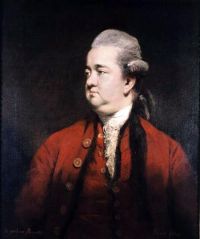 Edward Gibbon,
History of the Decline and Fall of the Roman Empire…
Edward Gibbon,
History of the Decline and Fall of the Roman Empire…
“ The bolder forms of sculpture, in brass or marble, which peopled the temples of antiquity, were offensive to the fancy or conscience of the Christian Greeks: and a smooth surface of colors has ever been esteemed a more decent and harmless mode of imitation. ”
Helen A. Clarke, A Guide to Mythology (1908)
“ Let us drive apart the best of all the oxen of the Sun, and sacrifice them to the immortal ones, who dwell in the broad heaven. And if we come to Ithaca, our country, we will there build to the Sun, whose path is o’er our heads, a sumptuous temple, and endow its shrine with many gifts and rare. But if it be his will, approved by all the other gods, to sink our bark in anger, for the sake of these high-horned [159] oxen, I should choose sooner to gasp my life away amid the billows of the deep, than pine to death by famine in this melancholy isle. ”
Ernest Henry Short, A History of Sculpture
“ For ourselves we prefer to regard the work of the critical school as scaffolding which will doubtless lead to a permanent erection of ascertained fact. The “Ares,” the “Meleager,” and the “Apoxyomenus” may be neither by Scopas nor Lysippus. It is sufficient if we can honestly detect in them the general characteristics of particular phases of fourth-century sculpture. The “Mausoleum Charioteer,” the “Menelaus and Patroclus,” and the “Niobe” group may none of them be the actual design or handiwork of Scopas. ”
Dudley Wright, The Eleusinian Mysteries and Rites
“ The "fair young god," Iacchos, or Dionysos, or Bacchus, was the son of Jupiter and Ceres, and accompanied the goddess in her search for Persephone. He also carried a torch, hence his statue has always a torch in the hand. This statue, together with other sacred objects, were taken from the Iacchion, the sanctuary of Iacchos in Athens, mounted on a heavy rustic four-wheeled chariot drawn by bulls, and, accompanied by the Iacchogogue and other magistrates nominated for the occasion, conveyed from the Kerameikos, or Potter's Quarter, to Eleusis by the Sacred Way in solemn procession. ”
 H. Rider Haggard,
King Solomon's Mines
(1907)
H. Rider Haggard,
King Solomon's Mines
(1907)
“ But the colossal Death, who sits at the head of the board, is far older than that, and, unless I am much mistaken, owes his origin to the same artist who designed the three Colossi. He is hewn out of a single stalactite, and, looked at as a work of art, is most admirably conceived and executed. Good, who understands anatomy, declared that, so far as he could see, the anatomical design of the skeleton is perfect down to the smallest bones. ”
