
“ IanThe clocks! Bring them! [Seizes the spade over by the house; begins to dig a grave behind the sun-dial.] Bring every one! We will bury the clocks before the sun-dial—an offering, a living sacrifice. I tell you this is great, Eloise. What is a clock? Something agreed upon and arbitrarily imposed upon us. Standard time. Not true time. Symbolizing the whole standardization of our lives. Clocks! Why, it is clockiness that makes America mechanical and mean! Clock-minded! A clock is a little machine that shuts us out from the wonder of time. ”
Standard time
Definition and stakes
The theme of “standard time” has been addressed by authors such as H. G. Wells, active 1857-1887 James W. Benson, James Arthur, John Locke and Arthur Hayden. It is often associated with terms like clock, watch, day, timekeeping and Sun.
Quotes about “standard time”
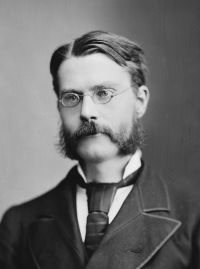 Edward Singleton Holden,
Popular Science Monthly
(1877)
Edward Singleton Holden,
Popular Science Monthly
(1877)
“ The improvement of the balance-watch upon the clepsydra or the hour-glass and other early time-keepers caused the change to be made from apparent to mean time, and the increasing requirements of a complex civilization demand more and more attention to the keeping of accurate standard time. ”
Henry Atkinson, A Rational Wages System
“ The allowances on the fastest time in order to obtain standard time is a matter more open to arrangement. It is, in fact, one of the most vital matters in connection with the time study system, and one where the most unfairness will take place. ”
Harry Jones, Once a Week (1862)
“ The clock strikes with a steady pulse, though sometimes it seems in a fever—sometimes in a fit. At any rate we have some fixed standard to correct the calculation of our waking time; but in dreams the standard itself is visionary. ”
Popular Science Monthly (1877)
“ A simple contrivance, connected with the tubes and the clock, lets off a puff of air every minute or half-minute, and the fingers of all the clocks in the system are in that manner pushed forward with unerring accuracy, in accordance with the time indicated by the standard timepieces in the observatory, so that exact uniformity can be maintained without difficulty in the time shown on any number of dials. ”
Project Gutenberg, The Gutenberg Webster's Unabridged Dictionary…
“ Standard time, the civil time that has been established by law or by general usage over a region or country. In England the standard time is Greenwich mean solar time. In the United States and Canada four kinds of standard time have been adopted by the railroads and accepted by the people, viz., Eastern, Central, Mountain, and Pacific time, corresponding severally to the mean local times of the 75th, 90th, 105th, and 120th meridians west from Greenwich, and being therefore five, six, seven, and eight hours slower than Greenwich time. ”
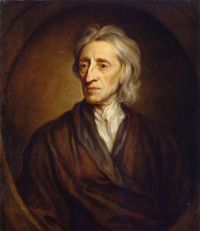 John Locke,
An Essay Concerning Human Understanding…
John Locke,
An Essay Concerning Human Understanding…
“ A good measure of time must divide its whole duration into equal periods. In the measuring of extension, there is nothing more required but the application of the standard or measure we make use of to the thing of whose extension we would be informed. But in the measuring of duration this cannot be done, because no two different parts of succession can be put together to measure one another. ”
active 1857-1887 James W. Benson, Time and Time-Tellers
“ But the regulating, as a matter of course, requires a regulator, or standard, of time, which is not always to be found in country places, nor even is the man in charge of clock-winding always in possession of a watch sufficiently accurate to convey the time from the regulator if there were one to the Church clock. Of late, Church clocks are made to go eight days, and so the labour of frequent winding has been saved, while at the same time by extra care in the [ 145] manufacture and fixing of a clock, there need be no necessity for frequently regulating it. ”
Edmund Arthur Engler, Popular Science Monthly (1882)
“ To railroad-men and watch-makers as a matter of necessity, to manufacturers and business-men as a matter of economy, and to individuals as a matter of convenience, it has come to be highly important to know what is the exact time of day to the second, in circumstances where half a century ago it would have quite sufficed to know the minute or even the hour. ”
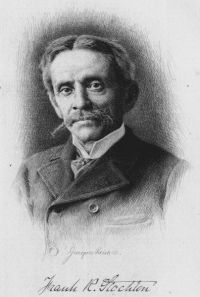 Frank R. Stockton,
Fanciful tales
(1922)
Frank R. Stockton,
Fanciful tales
(1922)
“ If you set back a clock, even as little as ten minutes, you add that much to the time that has passed. The hour which has just gone by has been made seventy minutes long. Now, no human being has the right to add anything to the past, nor to make hours longer than they were originally [73] made. ”
active 1857-1887 James W. Benson, Time and Time-Tellers
“ The Winding and keeping in order is, as we have said, a less laborious task as respects modern clocks than those which were made fifty years ago, inasmuch as, although it is the duty of a clock-winder to watch daily the action of the time-piece under his charge, he need not perform his winding duties oftener than once a week. ”
Jaime Luciano Balmes, Fundamental Philosophy, Vol. 2…
“ For if we suppose the time marked to be an hour, the space passed over by the minute hand, that is, the circumference of the dial, has no relation with the hour except what the artificer gave it by so constructing the watch that the minute hand would make one revolution every hour. ”
Arthur Hayden, Chats on Old Clocks
“ It is well that modern clocks have no wise saws and [Pg 32] mottoes telling of the unalterable hand of Time; "Old Time, the clock-setter, that bald sexton, Time," as Shakespeare says in King John.Early Mechanism.—The problem for the old clockmakers who wished to supplant the primitive measurement of time by candle, by the hour-glass, and later by the sundial, was to produce a piece of mechanism which would in twenty-four hours, the prescribed period of day and night, indicate the flight of time hour by hour. ”
 Thomas Henry Huxley,
Aphorisms and Reflections from the Works of T. H. Huxley
Thomas Henry Huxley,
Aphorisms and Reflections from the Works of T. H. Huxley
“ Let me illustrate my case by analogy. The working of a clock is a model of uniform action; good time-keeping means uniformity of action. But the striking of the clock is essentially a catastrophe; the hammer might be made to blow up a barrel of gunpowder, or turn on a deluge of water; and, by proper arrangement, the clock, instead of marking the hours, might strike at all sorts of irregular periods, never twice alike, in the intervals, force, or number of its blows. ”
Harry Chase Brearley, Time Telling through the Ages
“ Why, you might almost say it ran by clock-work! The millions of watches in millions of pockets, the millions of clocks on millions of walls, all running steadily together—these were what kept the complicated machinery of modern life from getting tangled and confused.Yes; but what did people do before they had such timepieces? Back in the very beginning, before they had invented or manufactured anything—far back in the days of the caveman—even those people must have had some method of telling time. ”
William James, Psychology: Briefer Course
“ Our only way of knowing it accurately is by counting, or noticing the clock, or through some other symbolic conception. When the times exceed hours or days, the conception is absolutely symbolic. We think of the amount we mean either solely as a name, or by running over a few salient dates therein, with no pretence of imagining the full durations that lie between them. No one has anything like a perception of the greater length of the time between now and the first century than of that between now and the tenth. ”
Sir Henry H. Cunynghame, Time and Clocks: A Description of Ancient and Modern Methods of Measuring Time
“ Civil time is solar time averaged, so as to make the hours and days all equal. The difference between civil time and apparent solar time is called the equation of time, and is the amount by which the sun-dial is in advance of or in retard of the clock. In setting a dial by means of a watch, of course allowance must be made for the equation of time. ”
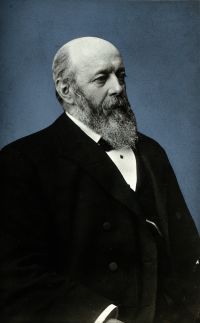 John Gray McKendrick,
Life in Motion
(1892)
John Gray McKendrick,
Life in Motion
(1892)
“ These questions lead us at once into another department of inquiry of immense importance in science—the measurement of time, and more especially the measurement of minute periods of time. We all recognise more or less the value of time, and the busier we are the more we value what we call fragments of time. On a long summer day in the holidays, when we have not much to do except gratefully to enjoy the beauties of nature and the sense of physical well-being, a quarter of an hour, or even an hour, is not appreciated as of much value ”
 John Henry Newman,
An Essay in Aid of a Grammar of Assent
John Henry Newman,
An Essay in Aid of a Grammar of Assent
“ We do not dispense with clocks, because from time to time they go wrong, and tell untruly. A clock, organically considered, may be perfect, yet it may require regulating. Till that needful work is done, the moment-hand may mark the half-minute, when the minute-hand is at the quarter-past, and the hour hand is just at noon, and the quarter-bell strikes the three-quarters, and the hour-bell strikes four, while the sun-dial precisely tells two o’clock. ”
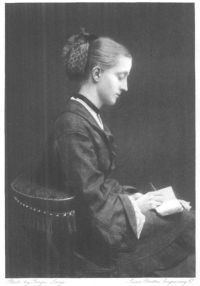 Juliana Horatia Ewing,
Miscellanea
Juliana Horatia Ewing,
Miscellanea
“ Either you will count twenty-four hours on the clock, or you will stay through all the light of one day, and all the darkness of one night. That is, you will count time either by the Clock or by the Sun.Now we say that there are 365 days in the year. But there are really a few odd hours and minutes and seconds into the bargain. The reason of this is that the Sun does not go by the Clock in making the days and nights. Sometimes he spends rather more than twenty-four hours by the Clock over a day and night; sometimes he takes less. ”
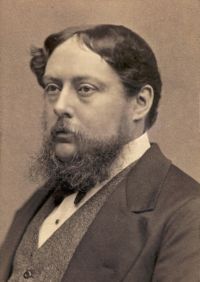 Richard A. Proctor,
Rough Ways Made Smooth: A series of familiar essays on scientific subjects
Richard A. Proctor,
Rough Ways Made Smooth: A series of familiar essays on scientific subjects
“ We find, say, that as compared with our watch time, one clock is two minutes fast, the next three minutes fast, the next one minute slow, and so on, two or three perhaps being as much as six or seven minutes fast, and two or three being as much as three or four minutes slow as compared with the watch. We note, however, that these wider ranges of difference occur only in the case of clocks presumably inferior—cheap clocks in small [Pg 68] shops, old clocks in buildings where manifestly the flight of time is not much noted, and so forth. ”
Maria Mitchell, Maria Mitchell: Life, Letters, and Journals
“ Now, just as she wrote, the clock, which I was careful not to meddle with, had been rapidly gaining time, and I was standing before it, watching it from hour to hour, and slightly changing its rate by dropping small weights upon its pendulum. Time is so important an element with the astronomer, that all else is subordinate to it. ”
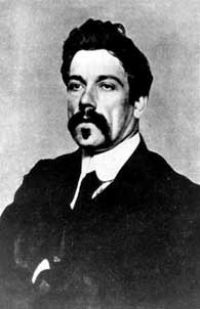 John Millington Synge,
The Aran Islands
(1912)
John Millington Synge,
The Aran Islands
(1912)
“ While I am walking with Michael some one often comes to me to ask the time of day. Few of the people, however, are sufficiently used to modern time to understand in more than a vague way the convention of the hours, and when I tell them what o'clock it is by my watch they are not satisfied, and ask how long is left them before the twilight. ”
William James, The Principles of Psychology, Volume 1…
“ The units of duration, on the other hand, which the time-sense is able to take in at a single stroke, are groups of a few seconds, and within these units very few subdivisions—perhaps forty at most, as we shall presently see—can be clearly discerned. The durations we have practically most to deal with—minutes, hours, and days—have to be symbolically conceived, and constructed by mental addition, after the fashion of those extents of hundreds of miles and upward, which in the field of space are beyond the range of most men's practical interests altogether. ”
Richard A. Proctor,
Light Science for Leisure Hours
“ But how can we test a time-piece whose motions32 we select to regulate every other time-piece? If a man sets his watch every morning by the clock at Westminster, it is clearly impossible for him to test the accuracy of that clock by the motions of his watch. ”
Sabin Hough, The Judgment Day (1849)
“ For example the absolute time of the moon's periodical revolution would note altered, but being measured by days, that had decreased in length, the period of the moon's revolutions would therefore appear to be longer, and would require an additional number of our minutes or seconds for their movements. ”
 John Timbs,
Things to be Remembered in Daily Life
John Timbs,
Things to be Remembered in Daily Life
“ I saw his famous clock last winter at Mr. George Graham’s: the sweetness of its motion, the contrivances to take off friction, to defeat the lengthening and shortening of the pendulum through heat and cold, and to prevent the disturbance of motion by that of the ship, cannot be sufficiently admired.”—Ms. Journal. [18] An exact measure of time is of the utmost importance to many of the sciences. Horology is indispensable to astronomy, in which the variation even of two or three seconds is of the greatest consequence. ”
Willis Duff Piercy, Great Inventions and Discoveries
“ The revolution of the earth around the sun marks the year; the revolution of the moon around the earth determines the month; the rotation of the earth on its axis causes and measures day and night. But no object of nature distinguishes the hours of the day or the divisions of the hour. Man requires a smaller unit of time than the day. He must divide the day into hours ”
James Arthur, Time and Its Measurement
“ We are constantly correcting their errors and never entirely succeed in getting them to run accurately to periods of time which exist entirely outside of such little things as men and clocks. So a clock is better as it approximates or bears a regular relation to some motion in nature. The sidereal clock of the astronomer does run to a regular motion; but our 24-hour clocks do not, as we shall see later. Now consider the year, or the sun's apparent motion in the Zodiac, from any given star around to the same one again. ”
 Algernon Blackwood,
The Extra Day — Chapter XIV: Maria Stirs
(1915)
Algernon Blackwood,
The Extra Day — Chapter XIV: Maria Stirs
(1915)
“ A clock is just a mechanical invention that ticks off the movements of the sun into seconds and minutes and hours. Both clocks and calendars, therefore, are mere measuring tricks. Time goes on, or does not go on, just the same, whether you possess these inventions or whether you do not possess them. Both clocks and calendars go at the same rate whether Time goes fast or slow. ”
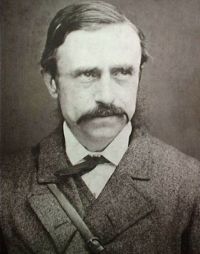 William Boyd Dawkins,
Early Man in Britain and His Place in the Tertiary Period
(1880)
William Boyd Dawkins,
Early Man in Britain and His Place in the Tertiary Period
(1880)
“ We do not know the length of the interval separating any two events not recorded in history, nor are we possessed of any natural chronometer by which to fix a date in the historical sense. We are dealing merely with time relative, and not time absolute. ”
Arthur Hayden, Chats on Old Clocks
“ The Several Branches of a Great Art.—The timekeeper—whether it be the scientific astronomical clock, or the chronometer used by mariners, or the modern watch, minute in size but recording time with accuracy, or the bracket or table clock, or the long-case clock—has proceeded on parallel lines of development. ”
Ernest Gallaudet Draper, Lectures in Navigation
“ You cannot manufacture a clock which will run that way because the hours of a clock must be all of exactly the same length and it must make noon at precisely 12 o'clock every day. Hence we distinguish clock time from sun time by calling clock time, mean (or average) time and sun time, apparent or solar time. From this explanation you are ready to understand such expressions as Local Mean Time, which, in untechnical language, signifies clock time at the place where you are; Greenwich Mean Time which signifies clock time at Greenwich ”
active 1857-1887 James W. Benson, Time and Time-Tellers
“ The sense of responsibility, of importance, which such a wonderful little piece of mechanism gives to them, the alacrity with which they thenceforth note the flight of time and compare the working of all other time-pieces, is remarkable. One of the first things usually done by the juvenile with his or her watch is, curiously enough, to challenge thereby the performance of the old-established time-pieces in the house,—even the infallible old Hall Clock, a very Nestor among clocks, does not escape scrutiny. ”
John Locke,
An Essay Concerning Human Understanding…
“ But the distinction of days and years having depended on the motion of the sun, it has brought this mistake with it, that it has been thought that motion and duration were the measure one of another. For men, in the measuring of the length of time, having been accustomed to the ideas of minutes, hours, days, months, years, &c., which they found themselves upon any mention of time or duration presently to think on, all which portions of time were measured out by the motion of those heavenly bodies, they were apt to confound time and motion ”
active 1857-1887 James W. Benson, Time and Time-Tellers
“ Complicated Watches are so called because besides the ordinary watch movement they possess other mechanism more or less complicated, by means of which they can indicate special portions of time,—as for instance the Chronograph, which marks on its dial the fifth of a second; the Quarter, and Half-Quarter, and Minute Repeaters, which furnish the time in the dark to within a minute, and are invaluable to invalids and blind persons; the Clock-Watch, which strikes the hours even in the pocket ”
Related terms
Authors who wrote about “standard time”
 H. G. Wellsactive 1857-1887 James W. BensonJames ArthurJohn LockeArthur Hayden
 William Shakespeare
 Marcel ProustRichard A. ProctorFrank R. StocktonHarry Chase Brearley
 Immanuel KantWilliam JamesSir Henry H. Cunynghame
 Robert Green IngersollJuliana Horatia EwingWilliam Hazlitt
 Samuel Johnson
 Marcus Aurelius
 Denison OlmstedA. Russell Bond