“ Mechanical Advantage.—A lever often gives an advantage because by its use one may lift a stone or weight which the unaided strength of man could not move. If the lever is used in lifting a stone weighing 500 lbs., the force available being only 100 lbs., then its mechanical advantage would be 5, the ratio of w:f. In a similar way, the mechanical advantage of any machine is found by finding the ratio of the resistance or weight to the effort. ”
Mechanical advantage
Definition and stakes
Mechanical advantage, a measure of force amplification achieved through tools or machines, underpins the efficiency of mechanical systems by exchanging input force for movement. This principle, grounded in the law of the lever, has been examined by authors such as Thomas D. Cope, who demonstrates its practical use in lifting heavy weights with minimal exertion, and Henry Kater, who observes that while machines may not always offer mechanical advantage, they enhance the direction of power for convenience.
Edwin A. Pratt points out constraints in applying mechanical power to transportation, while Archibald Williams stresses innovations in machinery that enhance pulling effect. These diverse viewpoints highlight mechanical advantage’s dual function as both a theoretical foundation and a practical instrument in engineering, revealing its lasting significance in analyzing force, motion, and efficiency.
Quotes about “mechanical advantage”
Henry Kater, A Treatise on Mechanics
“ Hence it appears that no mechanical advantage is gained by this machine. Nevertheless, there is scarcely any engine, simple or complex, attended with more convenience. In the application of power, whether of men or animals, or arising from natural forces, there are always some directions in which it may be exerted to much greater convenience and advantage than others, and in many cases the exertion of these powers is limited to a single direction. ”
Henry Kater, A Treatise on Mechanics
“ In this instrument, therefore, the power acts upon the weight to a mechanical disadvantage, inasmuch as a greater power is necessary to support or move the weight than would be required if the power were immediately applied to the weight, without the intervention of a machine. We shall, however, hereafter show that the advantage which is lost in force is gained in despatch, and that in proportion as the weight is less than the power which moves it, so will the speed of its motion be greater than that of the power. ”
Edwin A. Pratt,
A History of Inland Transport and Communication in England…
(1912)
“ Their nature almost prohibits the application of mechanical power to advantage in the conveyance of goods and passengers upon them; and they have not, therefore, partaken of the benefits which other arts have derived from mechanical science. ”
William Henry Holmes,
Ancient art of the province of Chiriqui…
“ We observe that irregular and complex forms, in the production of which mechanical appliances could not be used to advantage, are modeled with as much grace of contour and perfection of surface as are the simpler shapes that could be turned upon a wheel, and we conclude that with this remarkable people the hand and the eye were so highly educated that mechanical aids were not indispensable. ”
Edward Huntington Williams, Every-day Science: Volume 6. The Conquest of Nature
“ Yet this remarkable contrivance, with all its massive steel beams and chains and cog wheels, employs no other principles than the simple ones of lever and pulley and inclined plane that we have just examined. The power that must be applied to produce a given effect may be calculated to a nicety. The capacities of the machine are fully predetermined in advance of its actual construction. But of course this is equally true of every other form of power-transmitter with which the modern mechanical engineer has to deal. ”
Archibald Williams, The Romance of Modern Mechanism
“ It constitutes, in my belief, the solution of one of the most difficult mechanical problems, and deserves to be considered as an invention quite apart from any particular means by which it is actuated, whether it is placed upon a self-propelled carriage or a vehicle drawn by any agency, mechanical or otherwise.... The way in which all four wheels are driven simultaneously so as to give the maximum pulling effect by means of elastic connection is in itself sufficient to mark the engine as a most valuable departure from common practice. ”
Robert S. Ball,
Experimental Mechanics
“ The velocity ratio of the former machine is nearly double that of the latter, and its mechanical efficiency is nearly four times as great. Less than half the applied power is wasted in the wheel and axle, while more than half is wasted in the differential pulley. This makes the wheel and axle both a more powerful machine, and a more economical machine than the differential pulley. ”
Robert S. Ball,
Experimental Mechanics
“ The mechanical powers are usually enumerated as follows:—The pulley, the lever, the wheel and axle, the wedge, the inclined plane, [Pg 101] the screw. These different powers are so frequently used in combination that the distinctions cannot be always maintained. The classification will, however, suffice to give a general notion of the subject.186. Many of the most valuable mechanical powers are machines in which ropes or chains play an important part. Pulleys are usually employed wherever it is necessary to change the direction of a rope or chain which is transmitting power. ”
A. Frederick Collins,
Inventing for Boys
“ How to Experiment with Machines.—Any one who possesses the slightest bent for mechanics can work out improvements on devices like egg-beaters and monkey-wrenches and feel their way as they go along.But when it comes to designing and building real machines where numerous levers, gears, and springs are combined to make a working unit you should by all means read up on the subjects of work, energy and power, learn about the six mechanical powers—and the action of machines in general. ”
Emory Adams Allen, The Golden Gems of Life; Or, Gathered Jewels for the Home Circle
“ In the mechanical world do we not always find that the greater the exhibition of power the steadier and quieter the movement becomes? It is the rickety engine of but few horse-powers that goes with a fizz and a clatter, while the massive engine that supplies the motive power for acres of machinery goes almost noiselessly; and the sublimest exhibition of power in the universe—the movement of the heavenly bodies—proceeds in absolute quiet. ”
“ And the employment of the best mechanical skill, in addition to the use of the motor power to supersede horse power, proves the rapid and great advance of modern conveniences as contrasted with the old-fashioned, hand-power machines. ”
William Scoresby, Memorials of the Sea: My Father
“ Action and reaction being equal, the power exerted in raising or moving one heavy body must be exerted reversely against the earth, or other fixed body serving as a fulcrum to the lever, or for the attachment of one extremity of a tackle or series of pullies, or for the securing of the capstan spindle. Let the attachments of the machine and its object, however, be both afloat, and then any of the mechanical powers, like that of the wedge, will have an efficiency of double that of its ordinary operation where one part is a fixture. ”
D. H. Lawrence,
Reflections on the death of a porcupine and other essays
(1925)
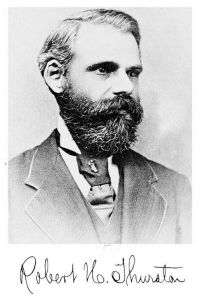
“ God is in the bush like a clenched dark fist, or a thrust phallus.{235}”So it is with every natural thing. It has a vital relation with all other natural things. Only the machine is absolved from vital relation. It is based on the mystery of neuters. The neutralising of one great natural force against another, makes mechanical power. Makes the engine’s wheels go round. ”
Robert Henry Thurston,
A History of the Growth of the Steam-Engine
“ All over the country, and even on the Continent of Europe, and in America, thousands of mechanics, and many men of mechanical tastes in other professions, were familiar with the principles of the new machine, and were speculating upon its value for all the purposes to which it has since been applied; and a multitude of enthusiastic mechanics, and a larger multitude of visionary and ignorant schemers, were experimenting with every imaginable device, in the vain hope of attaining perpetual motion, and other hardly less absurd results, by its modification and improvement. ”
Franz Reuleaux,
The Kinematics of Machinery
(1876)
“ It must be admitted, too, that the sense of the reality of this separation has been felt not only by Engineers or others actually engaged in machine design, but also by those theoretical writers who have had any practical knowledge of machinery, in spite of the increasing tendency in the treatment of mechanical science to thin away machine-problems into those of pure mechanics. ”
C. E. John Bourne, A Catechism of the Steam Engine
“ A.--The mechanical powers are certain contrivances, such as the wedge, the screw, the inclined plane, and other elementary machines, which convert a small force acting through a great space into a great force acting through a small space. ”
Edmund Edward Fournier d'Albe,
Hephæstus; or, The Soul of the Machine
(1925)
“ Had it been otherwise, an animal running on its own wheels would have made its appearance on earth long ago. The shaft of the steam engine could be provided with numerous pulleys, each capable of driving a machine connected with it by a belt. Then arose that marvellous crop of mechanical combinations which brought about the age of mechanism, combinations which, in the last resort, can be reduced to sliding couples and turning couples, and can be catalogued by means of formulæ, like words in a dictionary. ”
“ Sometimes they connect a moving wheel with the piston used in churning. In another place you see a cradle rocked with a motion the more gentle as it is produced by a fall of water moderated [Pg 40] with art. In short, a stranger who visits their country, perceives, at every step, the extraordinary turn of these people for the mechanical arts. ”
“ The study of motors and motive power is one which calls for the highest engineering qualities. In this, as in every other of the mechanical arts, theory, while it has an important function, occupies second place. ”
Various, Graham's Magazine, Vol. XLI, No…
“ In following the course of invention and rediscovery during the middle ages, and in subsequent times, we see two main causes of the superiority of our own useful arts to those of the ancients—the extended application of mechanical and chemical science. The discovery of the various problems in mechanics, which paved the way for the multiplication of human force, and the introduction of new motor powers, occupied chiefly the latter half of the sixteenth and the seventeenth century. ”
Carroll Davidson Wright,
1911 Encyclopædia Britannica, Volume 16…
(1911)
“ Every hoist and fly-wheel directly connected with mechanical power, and every part of a water-wheel or engine worked by mechanical power, and every wheel race, must be fenced, whatever its position, and every part of mill-gearing or dangerous machinery must either be fenced or be in such position that it is as safe as if fenced. ”
Daniel Webster,
The Works of Daniel Webster, Volume 1
“ The slightest glance, however, must convince us that mechanical power and mechanical skill, as they are now exhibited in Europe and America, mark an epoch in human history worthy of all admiration. Machinery is made to perform what has formerly been the toil of human hands, to an extent that astonishes the most sanguine, with a degree of power to which no number of human arms is equal, and with such precision and exactness as almost to suggest the notion of reason and intelligence in the machines themselves. ”
Robert S. Ball,
Experimental Mechanics
“ It is not always practicable to employ numerous hands for the purpose, nor is a steam-engine or other great source of power at all times available. But what are called the mechanical powers enable the forces at our disposal to be greatly increased. One man, by their aid, can exert as much force [Pg 100] as several could without such assistance; and when they are employed to augment the power of several men or of a steam-engine, gigantic weights, amounting sometimes to hundreds of tons, can be managed with facility. ”
Henry Dircks,
Perpetual Motion
“ As soon as a boy begins to take an interest in moving parts of machinery, vehicles, locomotives, and what not, he perceives that the application of power results in the motion of bodies, and again that bodies in motion are productive of power. A wheel moved by muscular, or other mechanical power, is made by machinery to elevate water, and elevated water can be made in descending to run machinery. The windlass, or other12 wheel, turned by applied force, lifts buckets from wells—raises stone, and elevates heavy bodies, if desired. ”
William Duane, A military dictionary
“ It is easy to conceive, that when forces applied to mechanical instruments are in equilibrium, if the least addition be made to one of them, it will preponderate and overcome the effort. But the want of a perfect polish or smoothness in the parts of all instruments, and the rigidity of all ropes, which increases with the tension, are great impediments to motion, and in compounded engines are found to diminish about one fourth of the effect of the power. ”
Charles Tappan Haviland, Popular Science Monthly (1881)
“ It is not until correct mechanical notions become wrought into the very warp and woof of one's mental fabric that his deductions from them may fairly be presumed to be correct. Witness the absurd notions current only a very few years ago as to the possibility of constructing a "motor" that should, in some mysterious way, evolve force enough from a pint of water to propel a train of cars from Philadelphia to New York! ”
Charles Hose,
The Pagan Tribes of Borneo
“ It would be absurd to deny all recognition or knowledge of mechanical causation to people who show so much ingenuity in the construction of houses, boats, weapons, and a great variety of mechanical devices, such as traps, and in other operations involving the intelligent application of mechanical principles. ”
Dionysius Lardner,
The Steam Engine Familiarly Explained and Illustrated
“ Patents have been granted for many ingenious mechanical combinations to impart to the propelling surfaces such angles as appeared to the respective contrivers most advantageous. In most of these, however, the mechanical complexity has formed a fatal objection. ”
Charles Babbage,
On the Economy of Machinery and Manufactures
(1846)
“ In stating the broad principle, that all combinations of mechanical art can only augment the force communicated to the machine at the expense of the time employed in producing the effect, it might, perhaps, be imagined, that the assistance derived from such contrivances is small. ”
Charles Babbage,
Passages from the Life of a Philosopher
(1864)
“ Circumstances had changed, mechanical engineering had made much progress; the tools required and trained workmen were to be found in the workshops of the leading mechanists, the founder's art was so advanced that casting had been substituted for cutting, in making the change wheels, even of screw-cutting engines, and therefore it was very probable that persons would be found willing to undertake to complete the Difference Engine for a specific sum. ”
Charles H. Ham, Mind and Hand: Manual Training the Chief Factor in Education (1900)
“ The man who aspires to construct any great mechanical engineering work, like the Brooklyn Bridge, for example, must know the exact mechanical power of every piece of machinery he employs, as also the exact mechanical value of every piece of iron that enters into the structure; and these things he cannot know unless he is familiar with the entire series of iron manipulations, from those of the foundery to those of the machine-tool shop. ”
A. Russell Bond, Mechanics: The Science of Machinery
“ However, drawing an object on wheels is a decided improvement over sliding it along the road, for two reasons: the sliding friction at the axle is reduced to a minimum by choosing materials that will slide upon each other with comparatively little resistance, by polishing them smooth and by lubricating them. But even if these precautions were not taken there would be a distinct advantage in the use of wheels because of the relatively shorter travel at the axle than at the rim of the wheel. ”
Charles T. Porter,
Engineering reminiscences contributed to "Power" and "American machinist"
(1908)
“ Just in the degree that the standard of mechanical excellence is raised must the demand become more general for greater strength in machine tools, as indispensable to its attainment.“But what is the standard of strength? The anvil affords perhaps its best illustration. It is a strength enormously beyond that which prevents a tendency to chatter, a strength that under even the heaviest labor prevents the least vibration of any part of the tool, or any indication of effort more than if the object being cut were a mass of butter. ”
Alfred Charles William Harmsworth, Motors and Motor-Driving (1902)
“ By connecting any one member of a gear of this character with the engine shafting, and another with the wheels, and locking the third to the frame of the car, a great variety of adaptations can be made to meet special needs, this arrangement having the advantage of neatness and compactness, and having all the gear wheels in constant engagement with each other all the time. ”
Lester Chadwick,
Baseball Joe on the Giants; or…
“ While few mechanics have the opportunity to actually build an automobile, it is the knowledge which he must acquire about every particular device used, that enables him to repair and put such machines in order. ”