“ A mass of dark-red boulders, overlying a bed of umber rock, ran out into the water, closing, as with a protecting arm, one end of the little inlet, while the forest-clad hill, rising sheer from the point, shut out everything beyond. And then the road! bright terra cotta, winding round the [121] bluff through masses of foliage in every shade of green,—giant trees, a maze of undergrowth, and the dew-laden ferns and mosses, blazing with emerald fires under the vagrant shafts of sunlight;—dies cretâ notanda. ”
Terra cotta
Definition and stakes
Terra cotta, a term referring to both a natural earthenware material and a warm, earthy shade, has long fascinated artists, archaeologists, and writers. Its hue—reminiscent of sun-baked clay—appears in literary works from diverse contexts: Heinrich Schliemann noted its vivid red tones in ancient Troy’s artifacts, while Gene Stratton-Porter evoked its brilliance in describing moth wings.
Llewellynn Jewitt praised its artistry in ceramic works, and Viscountess Frances Garnet Wolseley highlighted its practical application in gardening. These perspectives emphasize terra cotta’s dual function as both a cultural emblem and a flexible material, connecting art, history, and daily use.
Quotes about “terra cotta”
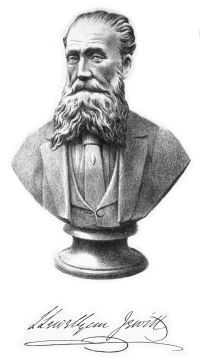 Llewellynn Frederick William Jewitt,
The ceramic art of Great Britain from pre-historic times down to the present day…
(1878)
Llewellynn Frederick William Jewitt,
The ceramic art of Great Britain from pre-historic times down to the present day…
(1878)
“ Figs. 832 to 834.—Blashfield’s Terra Cotta.In colour and quality the Stamford terra-cotta is of faultless excellence. The details are sharp, and in many cases exquisitely moulded; and, the body being much finer and harder than usual, they have a finish and a “touch” about them that cannot easily be surpassed.One of the most striking series of subjects produced in terra-cotta was the manufacturing “process panels” on the exterior of the Wedgwood Memorial Institute at Burslem. ”
 Charles Godfrey Leland,
A Manual of Mending and Repairing…
Charles Godfrey Leland,
A Manual of Mending and Repairing…
“ They chip a great deal before they break, just as agate might do.Terra-cotta is simply earth or clay “baked.” In most of the examples known as terra-cotta, earth predominates. Pure fine clay well fired is superior to what is generally called terra-cotta. Neither can we really class with it articles made of superior Portland cement, of which, as I have said, I have seen many made at Budapest which were like the finest hard slate.Many writers confuse majolica with faïence; others regard the latter as what we should call crockery, or such ware as ranges between glazed terra-cotta and porcelain. ”


Related terms
Authors who wrote about “terra cotta”
 Heinrich Schliemann
 John Henry MiddletonLlewellynn Frederick William JewittFrank QuattrocchiAlfred B. Searle
 Anatole FranceVariousCharles Godfrey LelandLouis H. GibsonViscountess Frances Garnet Wolseley
 William Wetmore StoryT. L. Haines
 Gene Stratton-Porter
 George Rawlinson
 Augustus J. C. Hare
 Ernest IngersollMichael Terry
 Henry Rowe SchoolcraftSamuel ButlerJames Ward