“ FOLLE-FARINE. BOOK I. CHAPTER I.Not the wheat itself; not even so much as the chaff; only the dust from the corn. The dust which no one needs or notices; the mock farina which flies out from under the two revolving circles of the grindstones; the impalpable cloud which goes forth to gleam golden in the sun a moment, and then is scattered—on the wind, into the water, up in the sunlight, down in the mud. What matters? who cares? ”
Farina
Definition and stakes
The theme of “farina” has been addressed by authors such as Marion Harland, Gesine Lemcke, Sylvester Graham, E. E. Kellogg and Friedrich Christian Accum. It is often associated with terms like flour, wheat, milk, gluten and sugar.
Quotes about “farina”
The New International Encyclopædia…
“ A food product called farina, similar to hominy, but with coarser granules than meal and finer than those of hominy, is made from white maize. A similar granulated preparation, prepared from the inner portion of the finest wheat, is similarly named. Both products are employed in the making of gruel, puddings, etc. Farina is an important constituent of numerous prepared foods that are called farinaceous on account of the starch that they contain. In botany the pollen of flowers was formerly called farina. ”
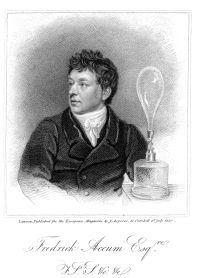 Friedrich Christian Accum,
A treatise on the art of making good wholesome bread of wheat…
Friedrich Christian Accum,
A treatise on the art of making good wholesome bread of wheat…
“ Yet the vegetable farina, in this state of existence, though highly 15nutritious, and to many palates very agreeable, is more difficult of digestion, and does not, upon the whole, afford a very wholesome alimentary substance. When too freely used, those kinds of seeds are sure to disagree, more especially if from age the oil has become rancid. They must be considered rather as a delicacy than as fitted to form a portion of our daily food, and with some particular stomachs they never agree. ”
E. E. Kellogg, Science in the Kitchen
“ Farina Blancmange.—Heat a quart of milk, reserving one half cup, to boiling. Then add two tablespoonfuls of sugar, and four heaping tablespoonfuls of farina, previously moistened with the reserved half cup of milk. Let all boil rapidly for a few minutes till the farina has well set, then place in a double boiler, or a dish set in a pan of boiling water, to cook an hour longer. Mold in cups previously wet with cold water. Serve with sugar and cream flavored with vanilla or a little grated lemon rind, mock cream, or cocoanut sauce. ”
Margaret Johnes Mitchell, The Fireless Cook Book
“ Farina Balls 1⁄2 cup farina 2 cups milk 1⁄2 teaspoon salt Dash of cayenne 5 drops of lemon juice Yolk of one egg Cook the milk and farina in a cooker for two hours or more, over boiling water, until all the liquid has been absorbed, then add the other ingredients while still over the water, and when well mixed remove it and spread it on a dish to cool. When cold, roll it into balls one inch in diameter, roll them in sifted crumbs, then in egg to which one tablespoon of water has been added and slightly beaten, and again in crumbs, and fry them in hot, deep fat until a golden brown. ”
Gesine Lemcke, Desserts and Salads
“ Farina Beignets.— Bring 1 pint milk with 1 tablespoonful butter to a boil and add, stirring constantly, 1 cup farina; continue stirring until it loosens itself from the bottom of saucepan; transfer the farina to a dish and when cold mix it by degrees with the yolks of 3 eggs, the grated rind of 1 lemon and 1 tablespoonful sugar; divide this into equal parts the size of an egg, roll them into oblong shapes, dip them into the beaten whites, roll in fine bread crumbs and fry in boiling lard; serve them dusted with sugar or send fruit sauce to table with them. ”
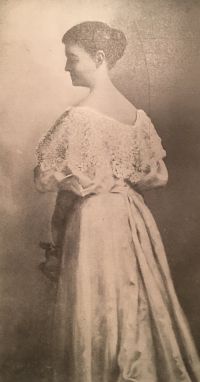 Mary Ronald,
Luncheons: A Cook's Picture Book
Mary Ronald,
Luncheons: A Cook's Picture Book
“ GNOCCHI À LA FRANÇAISE Add to a quart of boiling milk four tablespoonfuls of farina and half a teaspoonful of salt. Cook it about thirty minutes, or until soft. Turn it on to a dish, making a layer about half an inch thick. When it is cold and hardened cut it into sharp, triangular pieces. Arrange the pieces on a flat, round dish in a double circle as in illustration. Add to two tablespoonfuls of the hot boiled farina, one tablespoonful of butter, two tablespoonfuls of grated cheese, and a dash of paprika or red pepper. ”
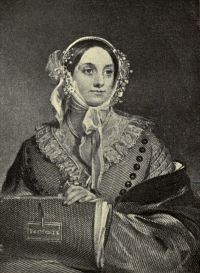 Eliza Leslie,
Miss Leslie's Lady's New Receipt-Book…
Eliza Leslie,
Miss Leslie's Lady's New Receipt-Book…
“ Boil the water and juice together. Then stir in gradually a quarter of a pound of farina, and boil it fifteen minutes longer. Transfer it to a mould, and set it on ice to congeal. Eat it with sweetened cream.FARINA PLUM PUDDING.—Having extracted the seeds from half a pound of the best raisins, cut them [438] in half, and dredge them well with sifted flour, to prevent their clodding, or sinking in the pudding. Pick, wash, and dry half a pound of Zante currants, and dredge them also with flour. ”
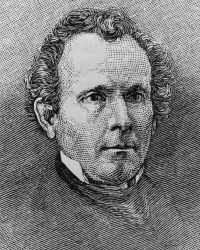 Sylvester Graham,
A Treatise on Bread, and Bread-making
(1837)
Sylvester Graham,
A Treatise on Bread, and Bread-making
(1837)
“ Thomson, of Edinburgh, one pound of good wheat meal contains ten ounces of farina or starch, three ounces of bran, six drams of gluten and two drams of sugar;—and it is because wheat contains such proportions of these substances that 74it makes the very best loaf bread. The farina or starch is the principal nourishing property;—the saccharine matter or sugar is also highly nutrient; but in the process of making loaf bread, it serves mainly, by its vinous fermentation, to produce the gas or air by which the dough is raised and the bread made light. ”
 Harlan F. Stone,
Federal Security Adm'r v. Quaker Oats Company…
Harlan F. Stone,
Federal Security Adm'r v. Quaker Oats Company…
“ Consumers who buy farina will have no reason to believe that it is enriched. Those who buy enriched farina are assured of receiving a wheat product containing those vitamins naturally present in wheat, and, if so stated on the label, an additional vitamin D, not found in wheat. ”
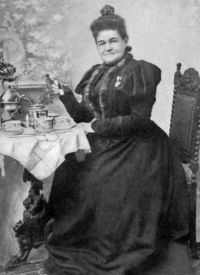 Marion Harland,
The Dinner Year-Book
Marion Harland,
The Dinner Year-Book
“ Work hominy, butter, and salt to a smooth paste; beat in the eggs, finally the chopped meat, after peppering and salting it. Stir up in a farina-kettle until hot, and pour out to cool. When cold, make into long rolls with floured hands, flour each well by rolling upon a dish, and fry to a yellow-brown in sweet lard. Drain off the fat and pile upon a hot dish. ”
Friedrich Christian Accum,
A treatise on the art of making good wholesome bread of wheat…
“ With us, wheat is chiefly employed for the fabrication of bread. It is, in fact, the only grain of which light porous bread can be made; but rye and barley are also used as bread-corn. The farina of the other cerealia afford also a nutritive and wholesome bread; though their flour is not so susceptible of the panary fermentation, it cannot be made into the white texture of the wheaten loaf. The bread formed from them is consequently much inferior to that prepared from wheat. ”
Lina Wachtelborn Meier, The Art of German Cooking and Baking… (1922)
“ Quantity for 6 Persons. 1⁄2 pt. milk 4 tbsps. fine farina 1 egg 1 tsp. of butter 1⁄4 tsp. of salt 1 pinch of nutmeg Preparation: The milk is brought to a boil, stir in the farina and butter and salt, then boil 3 or 3 minutes, stirring constantly until the mass loosens from the pot. Take from the stove, stir into it the yolk of egg. Beat the white of the egg to a froth and add to the mass. When it is cool make small dumplings, or you may also cut into sponges with teaspoon. Let the bouillon boil 5 minutes with the dumplings. Some chopped parsley in the soup is very good. ”
Florence Kreisler Greenbaum, The International Jewish Cook Book
“ FARINA DUMPLINGS Beat yolks of four eggs with three tablespoons of goose, turkey or chicken fat, but if these are not convenient, clear beef drippings will do. Put in enough farina to make a good Batter. Beat whites of eggs to a stiff froth with pinch of salt, and stir in batter. Put on in large boiler sufficient water to boil dumplings and add one tablespoon of salt. When boiling drop in by tablespoons. ”
Eliza Leslie,
Miss Leslie's New Cookery Book
“ FARINA BLANCMANGE.— From a quart of rich milk take out half a pint. Put the half pint into a small sauce-pan, and add (if permitted) sufficient mace, nutmeg, and cinnamon to flavor it well; the spices being tied up in a very thin muslin bag. Then add the flavored milk to the remainder, having stirred in two heaped table-spoonfuls of powdered loaf sugar. Set it over the fire in a porcelain kettle, and when it has come to a boil sprinkle in, gradually, four large heaping table-spoonfuls of farina, stirring it well. Keep it boiling a quarter of an hour after all the farina is in. ”
active 1823-1849 Mary Eaton, The Cook and Housekeeper's Complete and Universal Dictionary…
“ The farina of grain, and the seeds of vegetables, contain more of the nutritious and essential parts of the plant than any other, as is evident from the use of celery seed, the eighth part of an ounce of which will give more relish to a gallon of soup, than a large quantity of the root or stalk. On the same principle, the fat is the essence of meat, nearly so as the seeds of plants are of their respective species. To establish this fact, a simple experiment will be sufficient. Boil from two to four ounces of the lean part of butcher's meat in six quarts of water, till reduced to a gallon. ”
Frederick Arthur Ambrose Talbot, Millions from Waste (1920)
“ Turning once more to the utilization of farina as a constituent of the loaf, we encounter a possible development which should play a very emphatic part towards rendering ourselves less dependent upon foreign sources of wheat supplies. ”
Sylvester Graham,
A Treatise on Bread, and Bread-making
(1837)
“ But at whatever period in the history of the race, this artificial process was commenced, certain it is that in direct violation of the laws of constitution and relation which the Creator has established in the nature of man, this process of mechanical analysis is, at the present day, carried to the full extent of possibility; and the farina, and gluten, and saccharine matter of the wheat, are almost perfectly concentrated in the form of superfine flour. ”
 Mrs. H. W. Beecher,
Motherly talks with young housekeepers
(1873)
Mrs. H. W. Beecher,
Motherly talks with young housekeepers
(1873)
“ Then put it into a farina-kettle with half a pint of boiling water. Let it boil until soft enough to mash; drain it and mix it well with a pint of white corn meal or wheat flour, a little salt, and a pint and one half of milk in which two table-spoonfuls of butter have been melted. When nearly cold, add four table-spoonfuls of yeast; cover it, and set it in a warm place until very light, with the surface covered with bubbles. Butter some muffin-rings, set them on a hot griddle, pour into each a portion of the mixture, and bake them brown on both sides. Send them to table hot. ”
 Theodore Roosevelt,
Through the Brazilian Wilderness
(1914)
Theodore Roosevelt,
Through the Brazilian Wilderness
(1914)
“ When he has nothing else he eats the farina, as it is called, by the handful. It is seldom cooked. The small mandioc tubers when boiled are very good and are used instead of potatoes. Native beans are nutritious and form one of the chief foods. ”
Marion Harland,
Breakfast, Luncheon and Tea
“ Pare, core and slice the apples, and stew in a covered farina-kettle, without a drop of water, until they are tender. Mash to a smooth pulp, and, while hot, stir in butter and sugar. Let it get quite cold, and whip in, first the yolks of the eggs, then the whites—beaten very stiff—alternately with the bread-crumbs. Flavor, beat hard three minutes, until all the ingredients are reduced to a creamy batter, and bake in a buttered dish, in a moderate oven. ”
John T. Taylor, Cotton Weaving and Designing
“ Almost every manufacturer uses different proportions of ingredients. Many use wheat flour, farina, and sago mixed in various proportions, whilst a flour and farina mixture in the proportions of 2 : 1 is considered by some to give the best results. ”
E. E. Kellogg, Science in the Kitchen
“ For invalids able to digest solid food, rice, cracked wheat, Graham grits, oatmeal, barley, farina and other grains may be prepared and cooked as previously directed in the chapter on Grains.The various cooked preparations of grains—granola, wheatena, avenola, wheat gluten and gluten meal—manufactured by the Sanitarium Food Co., Battle Creek, Mich., form excellent articles of diet for many invalids, when served with hot milk or cream, or prepared in the form of mush. ”
Mrs. H. W. Beecher,
Motherly talks with young housekeepers
(1873)
“ Put the corn into the farina-kettle as above directed, with a little salt, pepper, two cups cream, one spoonful butter, or two cups sweet milk and two great spoonfuls of butter. Be sure and scrape all the milk from the cob when you have cut off the kernels, or squeeze it out with your hand. It adds more to the richness of the dish than you would at first imagine. Set the kettle over the fire and let it boil fifteen minutes. It will take less time to cook than when boiled on the cob. ”
Marion Harland,
The Dinner Year-Book
“ Put gelatine (soaked) , sugar, juice, peels, and spice into a bowl and pour the boiling water over them. Stir until dissolved; put over the fire in a saucepan, and heat almost to boiling. Pour, very gradually, upon the beaten yolks. Return to the fire—in a farina-kettle—and stir [201] one minute. It must not boil. Take it off, add the wine, and strain through double tarlatan.If you have ice, or if the weather be cold, set the mould containing this in the refrigerator, or in a very cool closet from Saturday to Monday. ”
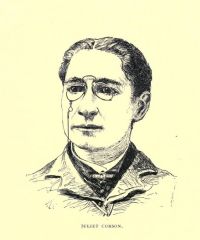 Juliet Corson,
The Cooking Manual of Practical Directions for Economical Every-Day Cookery
Juliet Corson,
The Cooking Manual of Practical Directions for Economical Every-Day Cookery
“ CHAPTER X. CHEAP DISHES WITHOUT MEAT."Bread is the staff of life;" in all ages and countries farinaceous foods have formed the bulk of man's sustenance; under this general term we include macaroni, which contains more gluten than bread and consequently is more nourishing, the different wheat flours, oat and barley meal, pearl barley, peas, beans, and lentils; the latter are the nearest article to meat in point of nourishment, containing heat-food in quantity nearly equal to wheat, and twice as much flesh food. ”
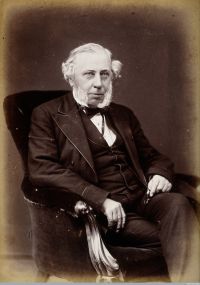 Charles West,
The Mother's Manual of Children's Diseases
Charles West,
The Mother's Manual of Children's Diseases
“ Chapman's Entire Wheat Flour is an extremely good food; and wheat, as you will remember, excels other farinaceous substances in its nutritive properties, but it is not so easy of digestion as Liebig. There is, however, scarcely any kind of farinaceous food, among which Nestlé's must not be forgotten, which may not answer for an infant; provided always that at first it is not given oftener than twice a day, that it is not made too thick, nor given in larger proportion than one-third of the farinaceous food to two-thirds of the whey, milk, or whatever it is mixed with ”
Helen Campbell, The Easiest Way in Housekeeping and Cooking
“ Under the first head, that of farinaceous seeds, are included wheat, rye, oats, Indian corn, rice, and a variety of less-known grains, all possessing in greater or less degree the same constituents. It will be impossible to more than touch upon many of them; and wheat must stand as the representative, being the best-known and most widely used of all grains. Each one is made up of nitrogenous compounds, gluten, albumen, caseine, and fibrine, gluten being the most valuable. Starch, dextrine, sugar, and cellulose are also found ”
Friedrich Christian Accum,
A treatise on the art of making good wholesome bread of wheat…
“ It is chiefly to save the trouble of dressing any other kind of food, and that bread, from its portability and convenience of always being ready, has become the principal sustenance, but it is far from being the most economical method of using farinaceous grain. ”
Friedrich Christian Accum,
A treatise on the art of making good wholesome bread of wheat…
“ The starch and gluten appear the most nutritious, and together with mucilage at the same time, the most abundant ingredients contained in those vegetables from which man derives his subsistence. Hence, from time immemorial, and in all parts of the earth, man has used farinaceous seeds 13as part of his food, for they contain the above-mentioned materials in the greatest abundance. Of these the most nutritive are the seeds of the Cerealia, under which title are commonly comprehended the Gramineæ, or Culminiferous plants. ”
 Jean-Henri Fabre,
Field, Forest and Farm
(1919)
Jean-Henri Fabre,
Field, Forest and Farm
(1919)
“ Of all the cereals wheat contains the most gluten, with rye holding second place. Maize and rice, as well as chestnuts and potatoes, are wholly lacking [7] in this ingredient; and for that reason flour made from them, rich though it be in starch, is not at all the kind of flour for bread. This will explain to you the superiority of wheat over all other farinaceous grains. “Wheat, the only cereal that can give us white bread, that superior bread which nevertheless is not always to your taste unless spread with a little butter, does not grow in all countries. ”
Friedrich Christian Accum,
A treatise on the art of making good wholesome bread of wheat…
“ There can be no doubt that the same quantity of farinaceous matter made into bread might, in other forms, be used to a much greater advantage; for the great art of preparing good and wholesome food is to convert the alimentary matter into such a substance as to fill up the stomach and alimentary canal without overcharging it with more nutritive matter than is requisite for the support of the animal, and this may be done either by bread, or by converting 21the mealy substance of which it is composed into other forms, of which there is a great variety. ”
Related terms
Authors who wrote about “farina”
Marion HarlandGesine LemckeSylvester GrahamE. E. KelloggFriedrich Christian AccumMrs. H. W. BeecherEliza Leslie OuidaMargaret Johnes MitchellMary RonaldJanet McKenzie HillHarlan F. StoneLina Wachtelborn MeierFlorence Kreisler Greenbaumactive 1823-1849 Mary EatonM. R. L. SharpeFrederick Arthur Ambrose TalbotTheodore RooseveltJohn T. TaylorThe chefs of the New York Cooking School