Involucre

Definition and stakes

Alfred Barton Rendle,  1911 Encyclopædia Britannica (1911)

“ At the base of the general umbel in umbelliferous plants a whorl of bracts often exists, called a general involucre, and at the base of the smaller umbels or umbellules there is a similar leafy whorl called an involucel or partial involucre. In some instances, as in fool’s-parsley, there is no general involucre, but simply an involucel; while in other cases, as in fennel or dill (fig. 15) , neither involucre nor involucel is developed. In Compositae the name involucre is applied to the bracts surrounding the head of flowers (fig. 2, i) , as in marigold, dandelion, daisy, artichoke. ”
Source: Wikisource

Benoît Mure,  Dr. B. Mure's materia medica (1853)

“ The flowers form little axillary heads, with from 15 to 20 flowers each, arising from an involucre with five divisions and supported by a somewhat filiform pedicle. Calix tubulous, monophyllous, with five teeth, and much shorter than the tube of the corol. The corol is monopetalous, of a yellowish white, tubulous, puffed up at its extremity, with five reflexed divisions, and five stamens with bilocular, connivent anthers which are longer than the corol. Ovary one-celled, flat at the top, whence proceeds a slender style, terminated by [139] a glandular stygma which is longer than the stamens. ”
Source: Gutenberg

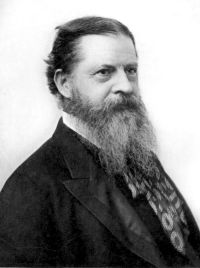
Portrait of Herbert Spencer Herbert Spencer,  The Principles of Biology — Appendix B(II) (1898)

“ And now, before leaving this question, let me remark on the strange proposition which has to be defended by those who deny the dwindling of organs from disuse. Their proposition amounts to this:—that for a hundred generations an inactive organ may be partially denuded of blood all through life, and yet in the hundredth generation will be produced of just the same size as in the first! ”
Source: Wikisource

Get perspective with Kwize: daily news enlightened by great literature