Cylinder (geometry)

Definition and stakes

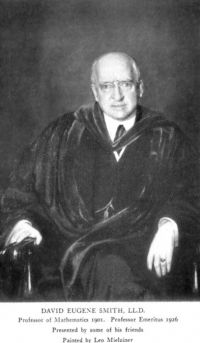
Portrait of David Eugene Smith David Eugene Smith,  The Teaching of Geometry

“ The mensuration of the volume of a cylinder depends upon the assumption that the cylinder is the limit of a certain inscribed or circumscribed prism as the number of sides of the base is indefinitely increased. It is possible to give a fairly satisfactory and simple proof of this fact, but for pupils of the age of beginners in geometry in America it is better to make the assumption outright. ”
Source: Gutenberg

Portrait of Petrus Ramus Petrus Ramus,  The Way To Geometry

“ From hence the capacity or content of cylinder-like [295] vessell or measure is esteemed and judged of. For the hollow or empty place is to be measured as if it were a solid body.
As here the diameter of the inner Circle is 6 foote: The periphery is 18.6/7: Therefore the plot or content of the circle is 28.2/7. Of which, and the heighth 10, the plaine is 282.6/7 for the capacity of the vessell. Thus therefore shalt thou judge, as afore, how much liquor or any thing else conteined, a cubicall foote may hold.
13. A Cylinder is the triple of a cone equall to it in base and heighth.
”
Source: Gutenberg

Portrait of David Eugene Smith David Eugene Smith,  The Teaching of Geometry

“ Archimedes also states that the surface of a sphere is two thirds that of the circumscribed cylinder, or the same as the curved surface of this cylinder. This is evident, since the cylindric surface of the cylinder is 2πr × 2r, or 4πr2, and the two bases have an area πr2 + πr2, making the total area 6πr2.
Theorem. The area of a spherical triangle is equal to the area of a lune whose angle is half the triangle's spherical excess.
”
Source: Gutenberg

Get perspective with Kwize: daily news enlightened by great literature