Various, Graham's Magazine Vol XXXII. No…
“ At the school, the child is treated as a man. The fresh air, the blue sky, the bright and happy hilarity of boyhood are too often proscribed indulgences. And this is called, not murder, but education. ”
Various, Graham's Magazine Vol XXXII. No…
“ At the school, the child is treated as a man. The fresh air, the blue sky, the bright and happy hilarity of boyhood are too often proscribed indulgences. And this is called, not murder, but education. ”
 Ellen Key,
The Century of the Child
“ Indeed before the school time begins, and in the hours out of school, children are as a rule taken by a maid servant to walk or to skate and so on. Children of the upper classes in most cases receive just as much, perhaps more, of their education from the nursery maid or from the school than from the mother. The father need not be mentioned at all, for as a rule he is an only occasional and unessential factor in the education of the child. ”
William James, Talks To Teachers On Psychology…
“ I heard a lady say that she had taken her child to the kindergarten, "but he is so bright that he saw through it immediately." Too many school children 'see' as immediately 'through' the namby-pamby attempts of the softer pedagogy to lubricate things for them, and make them interesting. ”
Ellen Key,
The Century of the Child
“ The educator wants the child to be finished at once, and perfect. He forces upon the child an unnatural degree of self-mastery, a devotion to duty, a sense of honour, habits that adults get out of with astonishing rapidity. Where the faults of children are concerned, at home and in school, we strain at gnats, while children daily are obliged to swallow the camels of grown people. ”
Adoniram Judson Ladd, On the Firing Line in Education
“ In the elementary school the pupil is a child, with the mind, the tastes, the ambitions of a child, and he should be allowed to remain a child. The ends in view are right habits, [Pg 231] right ideals, and knowledge facts. In the secondary school the student is an adolescent, with the mind of an adolescent, having peculiar and erratic tastes, changing ambitions, and conflicting emotions. ”
Charles A. McMurry, The Elements of General Method…
“ In unifying the various parts of school education, and in bringing them into close connection with children's other experiences, the school life fulfills one of its chief duties.Among other things tending toward consistency of character there must be harmony between the school and home life of a child. At home or among companions, perhaps unknown to the teacher, a boy or girl may be forming an habitual tendency and desire, more powerful than any other force in his life, and yet at variance with the best influence of the school. ”
Thomas Jefferson Ritter, Mother's Remedies
“ It is plenty early enough to send such a child to school when she is seven years old. This early school work rushes the child, makes it nervous. If you should happen to listen to the heart of many young school children you would find it pounding away at a furious rate. ”
 Dorothea Beale,
Work and Play in Girls' Schools
“ Even an ordinary child has her peculiarities, which should be allowed for, but, in the main, it is the regularity and uniformity of the school routine which make the most valuable part of her education. ”
 Elizabeth Robins Pennell,
Mary Wollstonecraft
“ As the “formation of the mind must be begun very early, and the temper, in particular, requires the most judicious attention,” a child’s training should be undertaken, not from the time it is sent to school, but almost from the moment of its birth. Therefore a few words as to the relations between parents and children are an indispensable introduction to the larger subject of education, properly so called, which prepares the young for social life. ”
W. Grant Hague, The Eugenic Marriage, Volume 1…
“ For the well-born, normal-minded, healthy-bodied child, who has wise and careful guardians or parents to assist in his mental guidance, the public school forms a good basis on which to build an education. ”
Charles Hubbard Judd, Introduction to the scientific study of education
“ At five or six years of age the pupil comes to the primary school. His experience is very limited; his senses are open to the impressions of color and sound and touch, and he eagerly or timidly mixes in the social group which is often to him bewilderingly large and strange. The key to the understanding of this period is to be found in the simple psychological principle that out of all the bewildering mass of childish experience it is persons who attract the child’s most vivid attention. ”
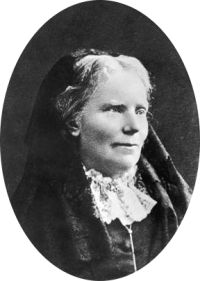 Elizabeth Blackwell,
Essays in medical sociology, Volume 1…
(1902)
“ With every step in life the child’s horizon enlarges, and opportunities of good or temptations to evil increase. The experiences of school-life, the companions selected, the studies pursued, and the books read, introduce the child into the wide world of practical life in miniature. All the circumstances of school-life are of serious importance—an importance not sufficiently realized in their bearing upon character, and in the responsibility which rests with parents themselves, to mould those circumstances. ”
Sidonie Matsner Gruenberg, Your Child: Today and Tomorrow
“ The social intercourse that the child experiences there, the regularity of hours, the teacher's personality, all have their favorable influence in the molding of the child's character. But neither must we overestimate the powers of the school. The school has the child but a few hours a day, for barely more than half the year ”
Woman's Club Work and Programs…
“ Training of the Human Plant. J. Mark Baldwin: Mental Development in the Child and the Race. G. Stanley Hall: Aspects of Child Life and Education. Irving King: Psychology of Child Development. [Pg 299] The school life of the child should be discussed from the standpoint of both parent and teacher. The watchful care over the child's morals is an important topic. The child's home work, how much should be done; and at what hours, is a subject for discussion. The school dress of little girls, the tidiness of both boys and girls, school lunches, the plays of the noon-hour, are all suggestive. ”
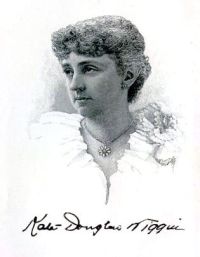 Kate Douglas Smith Wiggin,
Children's Rights: A Book of Nursery Logic
“ After spending five or six years at home or in the street, without training or discipline, the child is sent to school and is expected to learn at once. He looks upon the strange, new life with amazement, yet without understanding. ”
Mary Edward Feehan, Mostly Mary
“ I, too, would gladly help you with your studies, but I agree with Uncle about the proper time for such things. If there were no good schools for you to attend, we should engage a governess for you; but such an arrangement is not always best, either. In a schoolroom, a child learns much from hearing the others recite, and is taught many, many things not in books. At school, too, she has playmates of her own age. ”
 Leta Stetter Hollingworth,
Children Above 180 IQ Stanford-Binet…
“ These ideas persisted through the college careers, especially among the boys, many of whom felt they were misplaced in college at 15 years of age. Entering high school near the thirteenth birthday, a child saves time, and yet is not made subject to the tensions which may result from trying to meet social and physical requirements for which he is too immature. ”
G. A. Johnston, An Introduction to Ethics, for Training Colleges… (1915)
“ According to this argument, the child's character at school issues in departments of conduct which are quite other than those which express its life in the outer world. Now, there are, of course, obvious differences between the life that the child lives in school and the life that he lives outside and will live after his school-days are over. ”
Mosiah Hall, Parent and Child Volume III., Child Study and Training
“ A secondary purpose of the school is to assist the home to develop in the child the physical, mental, moral and social habits and ideals to which we have referred in previous lessons. To the shame of the home, it must be said that the school is accomplishing its particular function far better than is the home. The school rarely fails to exact obedience, regularity, punctuality, and industry from the pupil; the home, on the other hand, frequently fails to train children in these habits because of the softness and vacillation of the parents. ”
E. R. Murray, The Child Under Eight
“ In bringing children into school during their play period, probably the most important formative period of their lives, and in utilising their play consciously, we are interfering with one of their most precious possessions when they are still too helpless to resent it directly. ”
Marguerite Dickson, Vocational Guidance for Girls
“ We watch with delight the marvelous development of the little mind keeping pace with the growth of bodily strength and dexterity. We are reluctant to see the day drawing near when the child must begin his long course of training in school. Sometimes we fail to recognize the fact that before school days come the child has already received a considerable part of his education; that the habits which will make or mar his future are often firmly implanted and in a fair way to become masters of the young life. ”
Captain F. Brinkley, Japan: Its History, Arts, and Literature (1902)
“ Every child on attaining the age of six must now attend a Common Elementary School, where during a four years' course instruction is given in morals, reading, writing, arithmetic, the rudiments of technical work, gymnastics, and poetry. ”
Charles Herbert Sylvester, Journeys Through Bookland, Vol…
“ Outside of school for a considerable time each day the child falls under the influence of playmates who may or may not be helpful, but the greater part of every twenty-four hours belongs to the home. [2] Parents, guardians, brothers and sisters, servants, consciously or unconsciously, wisely or unwisely, are teaching all the time. It is from this great complex of influences that every child builds his character and lays the foundation of whatever success he afterwards achieves. ”
Francis B. Pearson, The Vitalized School
“ The child as the center in school procedure.—The child is the center of school procedure in all its many ramifications. For the child the building is erected, the equipment is provided, the course of study is arranged and administered, and the teacher employed. The child is major, and all else is subsidiary. In the general scheme even the teacher takes secondary place. Teachers may come and go, but the child remains as the focus of all plans and purposes. ”
Willard Grosvenor Bleyer, How To Write Special Feature Articles
“ Still, even the most miserly and most stubborn and most ignorant of parents can sometimes be made to see the wisdom of keeping a child in school until he is sixteen. They are won to the Job Lady's point of view by a statement of the increased opportunity open to the child who is sixteen. Or they are brought to see that the schools are for all children, and that work, on the contrary, is very bad for some children. ”
E. R. Murray, The Child Under Eight
“ Thus we summarise the chief business of the Nursery School teacher when we say that it is concerned chiefly with habits and play and right surroundings.Play in the Transition Class is less informal. After the age of six certain ambitions grow and must be satisfied. The aspects of life are more separated, and concentration on individual ones is commoner ”
Ellen Key,
The Century of the Child
“ The quietest, most obedient child is thought the best pupil, that is, the most impersonal individual is the model. So we see how the school confuses its conception of values. The [Pg 251] more the soul and body are passive, are willing to be controlled and receptive, so much the better are the results from the school standpoint. ”
Charles Hubbard Judd, Introduction to the scientific study of education
“ Has the school met the legitimate demand for a suitable education of the adolescent? The answer is that the school has been slow in meeting this situation. The archaic form of school organization which attached the seventh and eighth grades to the elementary school has hindered greatly a proper recognition of the special needs of adolescence. The child of twelve or thirteen does not need a review of the elementary work so much as a preparation for the active life of adulthood. The adolescent needs to be given an insight into the organization of society. ”
“ The younger boy, Bill, is six years younger and still at school, and having been a delicate child, or as his mother puts it, 'enjoying bad health,' is not promising for farm-work, and, being fond of his book and a favourite at school, his mother cherishes hopes of his becoming a school-teacher in days to come. ”
Adoniram Judson Ladd, On the Firing Line in Education
“ Little by little, as time has passed, the home seems to have been throwing added burdens upon the school until now it sometimes looks as if the school is expected to give the entire preparation of the child—moral, physical, and manual, as well as mental. ”
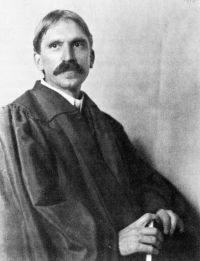 John Dewey,
The School and Society — The School and the Life of the Child
(1899)
“ If we roughly classify the impulses which are available in the school, we may group them under four heads. There is the social instinct of the children as shown in conversation, personal intercourse, and communication. We all know how self-centered the little child is at the age of four or five. ”
Mosiah Hall, Parent and Child Volume III., Child Study and Training
“ It can teach the obstinate, quarrelsome child better than can the home the necessity of adjusting his conduct to the requirements of the social group with which he associates. In school, frequently for the first time, a child learns what is meant by the ideals of duty and justice; furthermore, he is usually trained to habits of industry, perseverance and self-control which the home too often is not well prepared to teach. ”
Various, The Cumulative Book Review Digest…
“ It has been the author’s purpose to show the possibilities within the power of a parent of supplementing the work of the teacher, to show what is distinctly the teacher’s work and what the parent’s duty and privilege. “The pedagogue studies the laws of childhood; the parent, the temperament and needs of his particular child; the school-teacher advances the children in regiment, lock-step; the parent in their natural gait, in their strugglings and self-directed sprawlings.” ”
 William Jennings Bryan,
In His Image
“ The child is pushed through grade after grade, and, according to the statistics, a little more than ninety per cent, of the children drop out of school before they are old enough to decide educational questions for themselves. ”
 Fredrika Bremer,
The Homes of the New World
(1853)
“ She leaves discipline and severity to the school, to which the child is sent early. And the school does what it can; gives style and grace to the outward being, but leaves the inward very much, probably, as it found it. ”
Ray Coppock Beery, Practical school discipline (1917)
“ Develop the social consciousness in the child as early as possible. Make him realize that, for the general welfare of the whole school, it is worth his while to forego satisfying his need immediately. ”
 Virginia Penny,
The Employments of Women: A Cyclopædia of Woman's Work
“ The first two years of a child's schooling may be passed profitably in an infant school; at any rate, if the child enters as early as six years of age. Indeed, we think the variety embodied in the infant-school system is one of its most pleasing and useful features. ”
Dorothea Beale,
Work and Play in Girls' Schools
“ Parents should take interest in the school work; ask to see the written work; get to know the teachers and friends of their children; attend lectures, if possible, and supplement school lessons by home reading; perhaps join some common society, e.g., Teachers’ Guild, Parents’ Educational Union, or Child Study Society. ”
 Randolph Silliman Bourne,
The Gary Schools
(1916)
“ She may not be able to present these problems as well as the world will present them later, but the immediate and daily reaction while the child is in school should be invaluable in preparing him for meeting the more difficult problems which arise when he has completed his school course. ”
Francis B. Pearson, The Vitalized School
“ Parental attitude.—Schools are administered on the assumption that every child is capable of and worthy of training, and that training the child will make for a better quality of civilization. The state 20regards the child as a liability during his childhood in the hope that he may be an asset in his manhood. ”
 Maria Montessori,
The Montessori Method
“ If the child shows through its conversation that the educational work of the school is being undermined by the attitude taken in his home, he will be sent back to his parents, to teach them thus how to take advantage of their good opportunities. ”
Morilla Maria Norton, Outposts of Asia (1909)
“ The children enter the kindergarten at the end of the toddling age, and the little lads and lassies sit side by side in their delightful rooms and make their first songs of life, as they end them, together, their little arms and hands making the first efforts at rhythm together, awkward movements full of grace. They pass at eight years to the primary department and begin the toilsome upward pull of real study, and here their ways part,—the boys for the Peers’ School and the ruder ways of masculine effort. ”
 Alec WaughEllen KeyCharles Hubbard JuddAdoniram Judson LaddSidonie Matsner GruenbergRandolph Silliman BourneE. R. MurrayThomas E. SandersFrancis B. PearsonMosiah HallG. A. Johnston
 Thomas HughesJohn L. AlexanderJohn FitzwygramEvelyn DeweyMarguerite DicksonCharlotte M. MasonLeta Stetter HollingworthW. Grant HagueCharles A. McMurry
