Radius vector

Definition and stakes

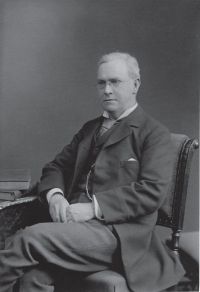
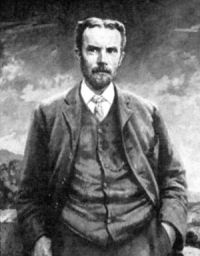
Portrait of James Clerk Maxwell James Clerk Maxwell,  A Treatise on Electricity and Magnetism (1873)

“ The vector-potential at a given point, due to a magnetized particle placed at the origin, is numerically equal to the magnetic moment of the particle divided by the square of the radius vector and multiplied by the sine of the angle between the axis of magnetization and the radius vector, and the direction of the vector-potential is perpendicular to the plane of the axis of magnetization and the radius vector, and is such that to an eye looking in the positive direction along the axis of magnetization the vector-potential is drawn in the direction of rotation of the hands of a watch. ”

Source: Wikisource

The Circle of Knowledge: A Classified…

“ The second law is rather less easy to understand. The radius vector is the line joining the sun to the planet at any moment; if we suppose the sun to be at the focus S, and P to be the planet, the radius vector at various positions of the planet will be represented by the lines SP, SP1, SP2, and so on. If the positions P, P1, P2, and so on, represent those which the planet occupies after equal periods of time—say, once a month—then the sectors of the ellipse bounded by each pair of lines, SP and SP1, SP1 and SP2, will be equal. ”
Source: Gutenberg

Garrett Putman Serviss,  Astronomy in a nutshell (1912)

“ If the orbit were a circle it is evident at a glance that the law must be true, because then the sun would be situated in the centre of the circle, the length of the radius vector, no matter where the planet might be in the orbit, would never vary, and the area swept over by it in one day would be equal to the area swept over in any other day, because all these areas would be precisely similar and equal triangles. ”
Source: Gutenberg

Get perspective with Kwize: daily news enlightened by great literature